Quickies by Douglas Flemons
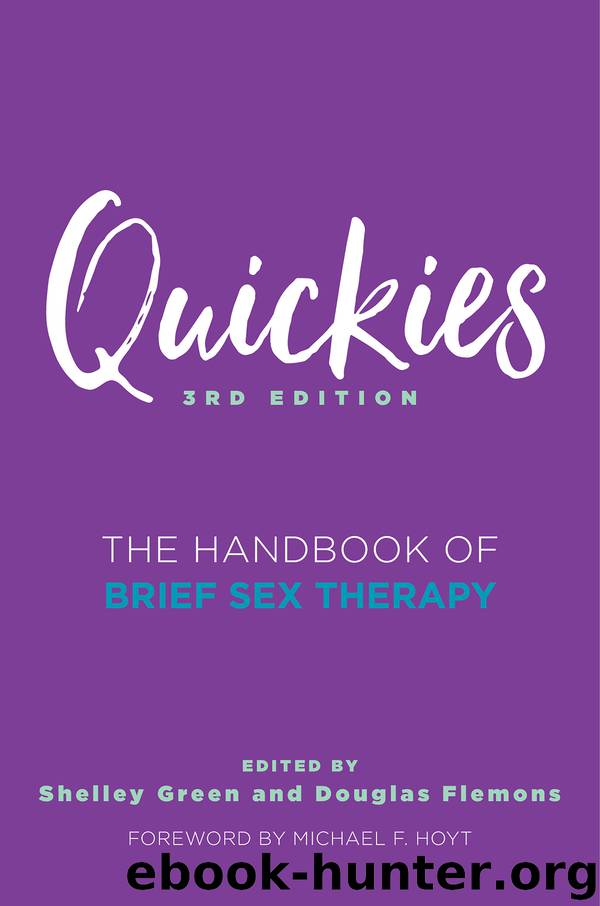
Author:Douglas Flemons
Language: eng
Format: epub
Publisher: W. W. Norton & Company
TRANS IDENTITIES AND TERMINOLOGY
We use the word trans as an umbrella term for a vast landscape of gender identities and expressions. Given that language is a living and ever-evolving system, terms might have already changed by the time you read this, or might be used differently by people in a range of communities. Thus, we aren’t aiming to provide a definitive and comprehensive list of identities and terminology, even though we have attempted to be inclusive of a vast range of experiences.
Before discussing sex therapy with trans clients, we thought it would be helpful to address gender, including trans identities and terminology, to ensure that we share a clear framework. Gender can, in fact, be a confusing term. It can be used to indicate a particular sociocultural context of identities, roles, and expressions associated with the concepts of masculinity, femininity, and androgyny in specific places and times. It can also be used as synonymous with sex, with gender and sex often being used interchangeably to refer to aspects of our neurobiology, identities, roles, and so on. In this chapter, we use sex and gender as distinct terms. For us, sex refers to the complex systems of chromosomes, hormones, and primary and secondary sex characteristics. People might be assigned as male, female, or intersex at birth, usually based on the appearance of their genitalia. Given that sex is also not binary, and that many aspects of our sex, such as our chromosomal make-up, are not immediately evident, very few people actually know for certain what their sex is. This is because most people are not tested for chromosomal make-up at birth, but are rather assigned a sex based only on the appearance of their genitalia. For this reason, we use the terms sex-assigned-at-birth or assigned-birth-sex to indicate which sex that people such as parents and health professionals might have given to a baby, based on a partial snapshot of their biological make-up and on the dominant culture’s gendering of these biological aspects.
Gender is a complex biopsychosocial construct. For the purposes of this chapter, we further divide the idea of gender into identity, expression, and role. Gender identity is the sense of ourselves, which often develops at a young age, even though we might not become conscious of it until later in life, depending on our position in relation to gender privilege, that is, whether we fit into dominant expectations of gender. Gender identity is about who we know ourselves to be. Terms to describe gender identity can include words like man, woman, Two-Spirit (an English-based term created and adopted by many indigenous people across the globe to reclaim identities and experiences beyond the gender binary that have been erased through settler colonialism), stud (a masculine lesbian), genderqueer (someone whose gender expression does not fit into the gender binary), trans woman (someone assigned male at birth and who identifies as a woman), trans man (someone assigned female at birth and who identifies as a man), person of transgender history (someone who identifies
Download
This site does not store any files on its server. We only index and link to content provided by other sites. Please contact the content providers to delete copyright contents if any and email us, we'll remove relevant links or contents immediately.
Rewire Your Anxious Brain by Catherine M. Pittman(18666)
Talking to Strangers by Malcolm Gladwell(13394)
The Art of Thinking Clearly by Rolf Dobelli(10510)
Mindhunter: Inside the FBI's Elite Serial Crime Unit by John E. Douglas & Mark Olshaker(9358)
Becoming Supernatural by Dr. Joe Dispenza(8234)
Change Your Questions, Change Your Life by Marilee Adams(7794)
Nudge - Improving Decisions about Health, Wealth, and Happiness by Thaler Sunstein(7717)
The Road Less Traveled by M. Scott Peck(7617)
The Lost Art of Listening by Michael P. Nichols(7515)
Mastermind: How to Think Like Sherlock Holmes by Maria Konnikova(7366)
Enlightenment Now: The Case for Reason, Science, Humanism, and Progress by Steven Pinker(7321)
Win Bigly by Scott Adams(7208)
The Way of Zen by Alan W. Watts(6624)
Daring Greatly by Brene Brown(6526)
Big Magic: Creative Living Beyond Fear by Elizabeth Gilbert(5784)
Grit by Angela Duckworth(5627)
Ego Is the Enemy by Ryan Holiday(5467)
Men In Love by Nancy Friday(5253)
The Laws of Human Nature by Robert Greene(5219)
